

The Story of Aran Yarn: Myth, Mist, and the Weight That Wasn't
A Name Born Three Thousand Miles Away
Here's the first surprise: on the Aran Islands themselves, nobody calls it "Aran weight."
Walk into a yarn shop in Galway or Dublin and ask for Aran weight, and you'll get a polite pause. In Ireland and the UK, this yarn weight goes by "medium" or sometimes "worsted." The term "Aran weight" is a North American invention, a marketing phrase that emerged in the mid-20th century when Irish cable-knit sweaters captured the imagination of American consumers.
The yarn didn't name itself after the islands. We did.

The Islands at the Edge of the World
The Aran Islands sit at the mouth of Galway Bay, three slabs of limestone battered by the North Atlantic. Inishmore, Inishmaan, Inisheer. For centuries, the people who lived there survived on fishing, farming thin soil they built by hand from seaweed and sand, and knitting.
The sweaters they made were not fashion statements. They were armor against horizontal rain and salt spray. Knit from báinín (pronounced "baw-neen"), an undyed cream-colored wool still rich with lanolin, these garments could shed water while trapping warmth. A fisherman's wife might spend 60 hours knitting a single sweater. It needed to last.
The Gansey Came First
The Aran sweater didn't spring from nothing. Its ancestor was the gansey (sometimes called a guernsey), a seamless knitted garment worn by fishermen across the British Isles since at least the 1800s. Ganseys were typically dark blue or navy, knit in the round with no seams to chafe during long days hauling nets.
The Aran style evolved as a regional variation: cream-colored instead of navy, decorated with elaborate cables, diamonds, and textured stitches. The oldest surviving Aran sweaters date only to the early 1900s, making this "ancient tradition" surprisingly young.
The Myth of the Clan Patterns
You've heard the story. Each family on the Aran Islands had its own unique pattern, passed down through generations. When a fisherman drowned and washed ashore unrecognizable, his sweater identified him. His stitches brought him home.
It's a beautiful story.
It's also almost entirely invented.
The tale appears to originate from J.M. Synge's 1904 play Riders to the Sea, where a drowned man is identified by his hand-knit stockings. Romantic accounts in the 1930s and 1940s expanded this into the clan-pattern mythology, which proved irresistible to tourists and marketers alike.
In reality, Aran knitters certainly had personal preferences and signature combinations, but there was no formal system of family patterns. Knitters borrowed, adapted, and invented freely. The "clan pattern" story persists because we want it to be true. And perhaps that wanting is its own kind of truth.
What the Stitches Actually Meant (Maybe)
While clan identification is myth, the stitches themselves do carry traditional associations:
- Cable patterns represent the fisherman's ropes, a wish for safety and good catch
- Diamond shapes suggest the small fields of the islands, a hope for prosperity
- Honeycomb stitches evoke the bees that provided sweetness and light
- Tree of Life patterns symbolize family unity, with branches reaching upward
- Basket weaves represent the fisherman's basket, abundance from the sea
- Zigzag patterns depict the cliff paths of the islands
- Moss stitch recalls the seaweed gathered for fertilizer and food
Were these meanings consciously intended by every knitter? Probably not always. But meaning accrues. Stitches absorb the hopes of the hands that make them.
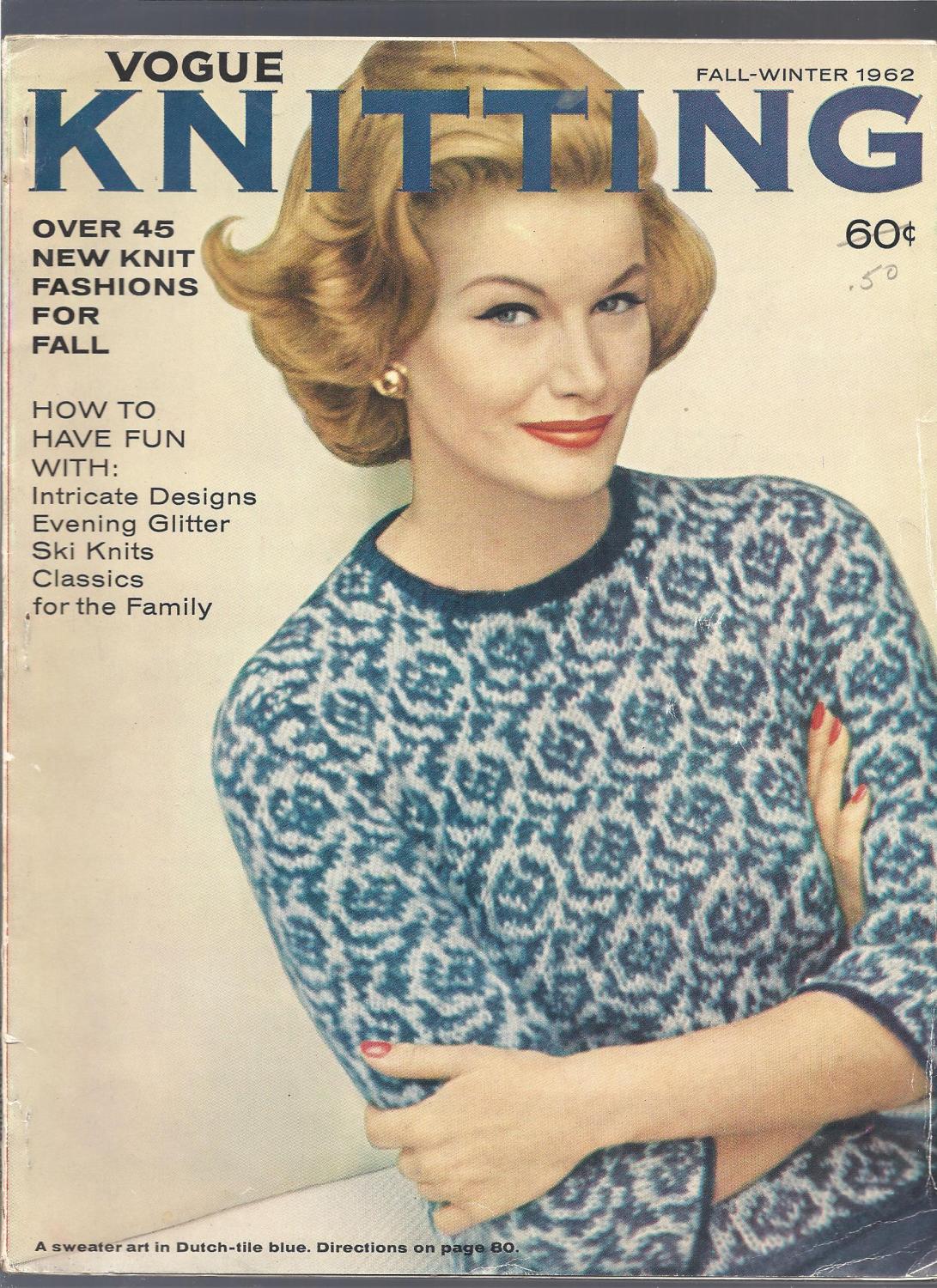
"Vogue Knitting, Spring/Summer 1962"
The Sweater Goes Global
In 1892, the Congested Districts Board began organizing Aran knitting as a cottage industry, helping islanders sell their work to the mainland. But the real explosion came later.
In 1962, Vogue featured an Aran sweater. Grace Kelly wore one. Steve McQueen wore one. The Clancy Brothers performed on The Ed Sullivan Show in matching Aran sweaters and suddenly everyone in America wanted one.
The irony was rich: a garment born from poverty and necessity became a luxury item, a signifier of rugged authenticity for people who had never hauled a fishing net in their lives.
The Yarn Itself
Traditional Aran sweaters were knit from single-ply or lightly plied wool, usually from local sheep. The yarn was minimally processed, retaining lanolin for water resistance. It was not soft by modern standards. It didn't need to be soft. It needed to work.
Today's Aran weight yarns range from rustic and sturdy to buttery merino blends. The weight itself typically knits at 4 to 4.5 stitches per inch on US 7 to 9 needles, sitting between worsted and bulky. It's the ideal weight for cables because the thicker gauge lets texture pop. Those traveling stitches need room to breathe.

Spinning Your Own Aran
For handspinners, Aran weight offers a satisfying middle ground: substantial enough to grow quickly on the bobbin, fine enough for defined stitch work. A 3-ply structure creates excellent stitch definition for cables. Aim for approximately 8 to 10 wraps per inch.
Consider fiber choice carefully:
- Wool with good memory (like Corriedale, Romney, or a sturdy merino) helps cables bounce back
- A touch of lanolin in minimally processed wool honors the tradition
- Rustic breeds like Shetland or Bluefaced Leicester add authenticity and durability
Or break tradition entirely. The Aran Islands are limestone and mist. Your sweater can be whatever you need it to be.

Fun fact: Iceland developed its own parallel tradition. Lopi yarn, spun from the fleece of sheep brought by Vikings over a thousand years ago, offers a similar heritage wool experience. Léttlopi is the Aran-weight workhorse of the Lopi line, while Plötulopi pencil roving can be handspun by traditional spinners.
Why It Endures
The Aran sweater survives because it works, aesthetically and practically. The cables aren't decoration for decoration's sake. They add thickness, insulation, and stretch. Form follows function, and function turns out to be beautiful.
But it also survives because of the story, mythologized or not. We want to believe in garments that carry meaning. We want our stitches to say something about who we are, where we come from, what we hope for.
Every cable you knit joins a conversation that spans generations. The patterns may not identify your clan.
But they'll still bring you home.