


Paradise Fibers Hand Dyed Wool Locks - USA Mixed Breeds (2.2oz Bags)
Paradise Fibers Hand Dyed Wool Locks - USA Mixed Breeds (2.2oz Bags)
SKU: SKU: WL-CMC-01
🧶 We'll wind your yarn into neat cakes for easy knitting/crocheting!

Order in --:--:-- for same-day shipping
Ships today from our Spokane, WA warehouse if you order by 1:00 PM PT
Couldn't load pickup availability
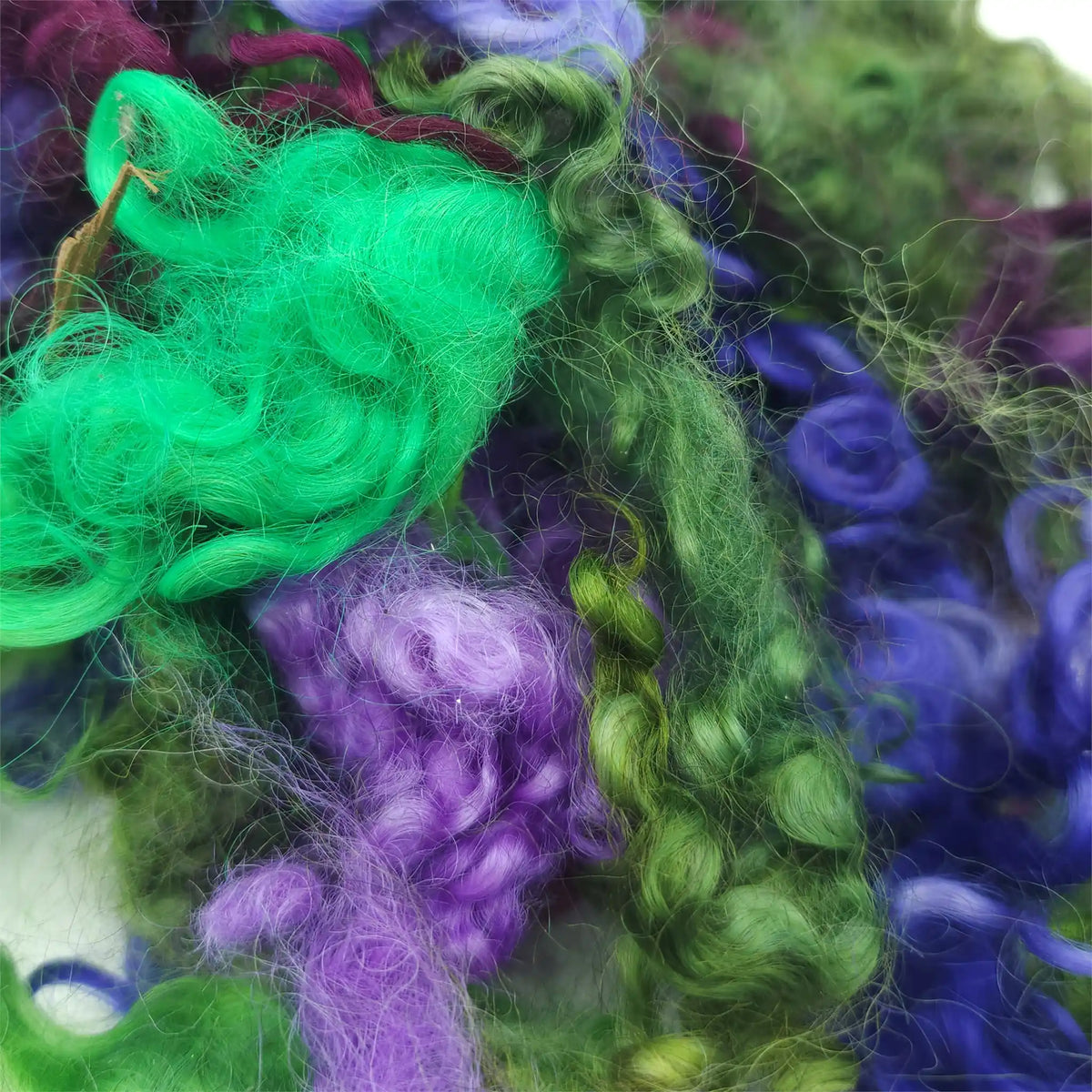
Hand dyed curly wool locks from American fiber farms, small batch dyed by Jennefer Marker of Compass Moon Creations. Each bag is a blend of breeds including Bluefaced Leicester, Lincoln, Cotswold, and mohair, all sourced from United States farms within roughly 100 miles of the dyer. The locks are washed and cleaned multiple times before they are hand dyed, so the color sits cleanly on fiber that is ready to work the moment you open the bag.
These locks are uncarded, meaning the natural curl of the fiber straight off the animal is preserved. That curl is the whole point. Locks are at their best where the ringlet shape is the feature: needle felted and wet felted sculptures, Santa beards, gnome beards, Waldorf and reborn doll hair, fairy hair, mermaid hair, and the curly coats of felted sheep and other creatures. Beyond felted work, they add dimension to jewelry, applique, quilting, mixed media, and paper craft, and a smaller community of art yarn spinners works the locks in lock by lock for sculptural handspun.
What You Can Make
- Needle felted and wet felted creatures with curls left long for fur and fleece
- Santa beards, gnome (Nisse) beards, and fairy hair for needle felted figures
- Waldorf doll hair and reborn doll rooting
- Sheep, lamb, and animal sculptures where the curl is the coat
- Mermaid hair, mane work, and other long curly hair on sculptural pieces
- Jewelry, applique, quilting, mixed media, and paper craft embellishment
- Art yarn singles with locks spun in for tassel and texture
Fiber Details
- Fiber content: blend of wool and mohair, typically Bluefaced Leicester, Lincoln, Cotswold, and mohair
- Weight: approximately 2.2 oz per bag
- Staple length: approximately 3 to 8 In, varies by breed
- Preparation: washed, scoured, hand dyed, uncarded
- Feltable: yes
- Origin: wool and mohair sourced from United States fiber farms, hand dyed in the United States by Compass Moon Creations
Please note: light bits of vegetable matter such as hay may remain in the locks. This is normal for uncarded fiber and most of it works free as you open the lock. Hand washing is recommended before use to test colorfastness, as hand dyed fiber may bleed lightly for the first wash or two.
The colorway runs through purple, green, yellow, lime, and lavender, with the exact balance varying from bag to bag since each batch is hand dyed in small lots. If a specific color balance matters for your project, get enough at one time to complete it.
Frequently Asked Questions
What are wool locks and what are they used for?
Wool locks are the curl structure of the fleece kept intact straight off the animal, rather than carded or combed straight. The natural ringlet is the whole point. Felters use locks for surface texture and as fleece on sculpted creatures. Doll and figure makers use them for Santa beards, gnome beards, Waldorf and reborn doll hair, fairy hair, and mermaid hair. Mixed media artists use them for color and texture in jewelry, applique, and wallhangings.
How are locks different from roving or top?
Roving and top are processed fibers aligned straight in a strip for predictable spinning. Locks keep the curl off the animal, which is the wrong choice for smooth conventional spinning but the right choice for any project where you want curl, texture, or sculptural surface.
Can I spin wool locks?
Yes, with the right technique. Some spinners pull lock by lock and let the curl ride out in the singles for a textured art yarn, sometimes called tail spinning or lock spinning. Smooth conventional spinning from locks requires flick carding or combing first, which is a worsted prep technique a smaller number of spinners do. For predictable smooth spinning, roving and top are easier choices than locks.
How much fiber do I need for a project?
One bag is enough for a Santa beard or two, hair on one or two Waldorf or sculpted dolls, fleece on a small to medium felted sheep, accent locks across several felted creatures, or trims for jewelry and applique. For larger projects, buy enough at once since colorways vary between batches.


Why Paradise Fibers?
Your trusted partner in creativity since 1997. Family-owned, expert-driven, and dedicated to fueling your passion.
Real "Fiberers" on Staff
Family-owned and staffed by passionate experts offering real advice to support your creative journey.
A World of Fiber
Over 20,000 in-stock yarns, fibers, and tools, shipped quickly to keep your inspiration flowing.
Trusted by the Flock
Serving over 250,000 happy customers with a 4.9-star rating based on 10,000+ verified reviews.
Frequently Asked Questions
Most in-stock orders ship within one business day from our Spokane, WA shop, and you'll get tracking as soon as yours is on the way. If an item is a special order or backordered, it says so right above the Add to Cart button.
Many of our products are beginner-friendly, and we make this clear in the product description.
You can also explore our kits and bundles, they include everything you need to get started with confidence.
Each fiber has its own feel and function. Merino is super soft and great for next-to-skin wear. BFL (Bluefaced Leicester) is strong, with a lovely luster. Need help deciding? Reach out! We’re happy to help.
For Yarn, check your pattern's yardage requirements. A standard pair of socks usually takes 100g of fingering weight, while a hat takes about 100g of worsted.For Spinning Fiber, a standard 4oz braid will generally make a pair of socks or a hat. For larger garments like sweaters, you will likely need 1.5 to 2 lbs of fiber.Still unsure? Send us your project details! We are happy to do the math for you to ensure you don't run short.
If a product goes out of stock after you order, we’ll notify you right away with options: a refund, a substitution, or a backorder (when possible). We never leave you hanging.
We offer 30-day easy returns on most unused products. If something arrives damaged or missing, we’ll make it right. Just contact our support team.
Yes! Our project kits and beginner bundles include hand-picked materials, tools, and instructions — so you can dive in without the guesswork.