


Spokane Hand Dyed Merino Roving Braids (100g) by HMLLOYD MERCANTILE
Spokane Hand Dyed Merino Roving Braids (100g) by HMLLOYD MERCANTILE
SKU: SKU: HML-PL12
🧶 We'll wind your yarn into neat cakes for easy knitting/crocheting!

Order in --:--:-- for same-day shipping
Ships today from our Spokane, WA warehouse if you order by 1:00 PM PT
Couldn't load pickup availability
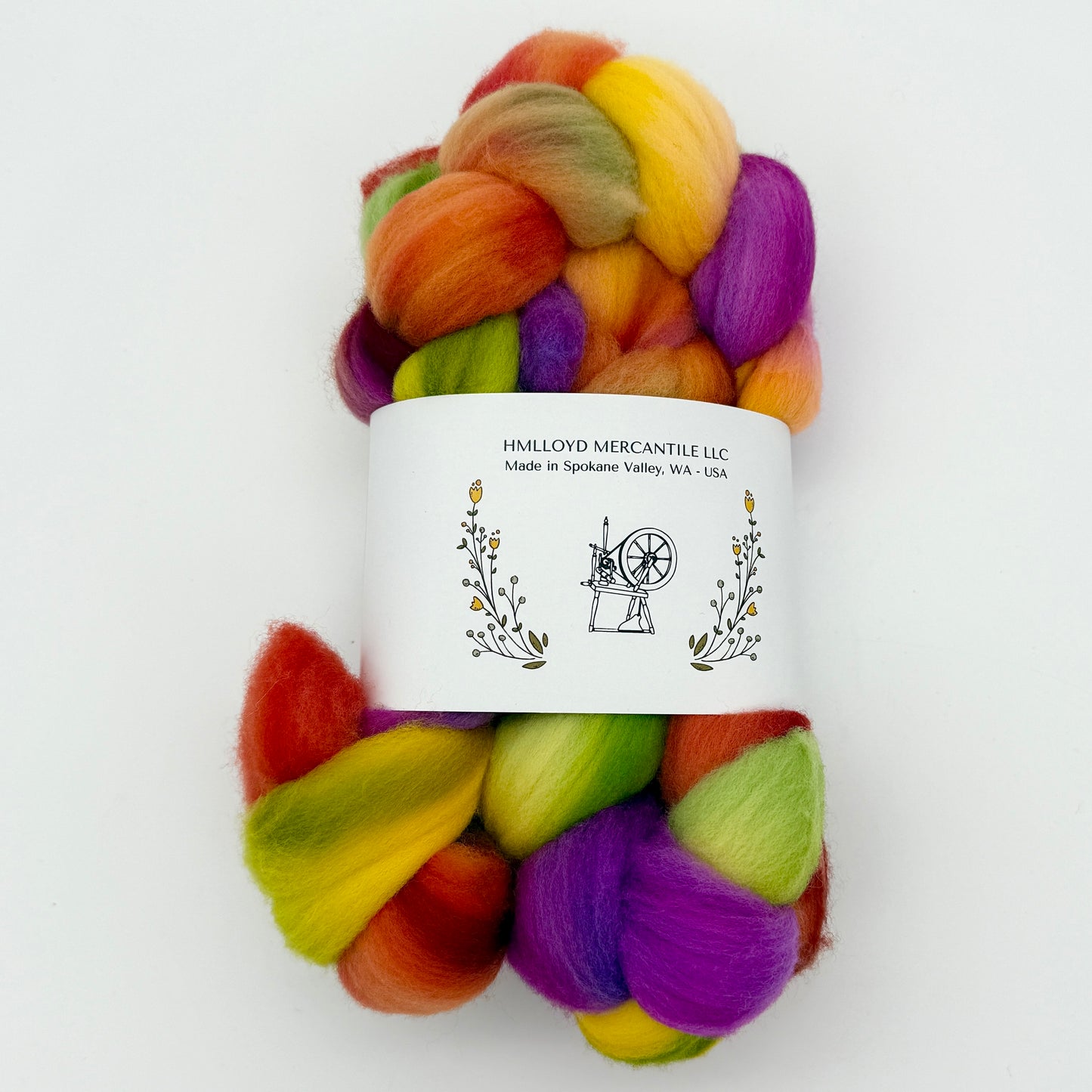
Hand dyed merino roving braids with Spokane-inspired colorways, dyed in small batches in Spokane Valley, Washington by indie dyer HMLLOYD MERCANTILE LLC. Each braid is 100 grams (3.5 oz) of soft 21.5 micron merino wool top, hand dyed in the braid with professional acid dyes. They are made for handspinning, and they also work well for felting and fiber blending. Paradise Fibers stocks them at our Spokane shop, a few miles from where they are dyed.
Specifications
- Fiber: 100% merino wool
- Fineness: 21.5 micron (soft enough to wear next to skin)
- Preparation: combed merino top, sold as a braid (spinners often call this roving)
- Weight: 100 g (3.5 oz) per braid
- Dye method: hand dyed in the braid with professional acid dyes
- Colorways: 5 (Pavilion Lights, Garland District, Monroe Street Bridge, Lilac City, Kendall Yards Night Market)
- Dyer: HMLLOYD MERCANTILE LLC, Spokane Valley, WA, USA
- Price: $30 per braid
The Spokane colorways
Every colorway is named for a Spokane landmark or neighborhood. The colors below describe the braids in our photos. Hand dyeing means each braid is a little different.
- Pavilion Lights: deep teal, charcoal gray, plum and blackberry purple, with flashes of bright turquoise and magenta. Named for the lit-up Pavilion in Riverfront Park, a landmark from Spokane's Expo '74 World's Fair.
- Garland District: coral pink, soft peach, teal, sunny yellow and green. Named for the historic Garland District in north Spokane, known for its vintage neon signs.
- Monroe Street Bridge: chocolate brown, rose pink, plum and deep purple. Named for the historic concrete arch bridge over the Spokane River falls in downtown Spokane.
- Lilac City: turquoise, aqua, deep teal, cobalt blue and violet. Named for Spokane's nickname, the Lilac City, celebrated every May with the Lilac Festival.
- Kendall Yards Night Market: orange, golden yellow, lime green, red and bright violet. Named for the summer evening market in the Kendall Yards neighborhood above the Spokane River.
What these braids are good for
- Handspinning: fine merino top drafts smoothly on a spinning wheel or drop spindle. Split the braid lengthwise and spin end to end for long color repeats, or strip it into thin sections for shorter, marled changes.
- Fractal and chain-plied yarns: dyed-in-the-braid color sections are ideal for fractal spinning or chain plying (Navajo plying) to keep the colors distinct.
- Wet and needle felting: merino felts readily, so these braids also work for nuno felting, wet felted pieces and color accents in needle felting.
- Fiber art and blending: use a braid on a blending board or drum carder, or for wall hangings and weaving accents.
About the dyer: HMLLOYD MERCANTILE LLC
HMLLOYD MERCANTILE LLC is a small independent fiber studio in Spokane Valley, Washington. From its local studio it offers hand dyed roving and yarn, handspun yarns and handmade soaps, and it is a vendor at the Spokane Fleece and Fiber Festival. These Spokane colorway braids are dyed locally and sold through Paradise Fibers, a fiber arts supplier in Spokane since 1997.
A note from the dyer on color: All braids are dyed with professional acid dyes. We strive to keep production consistent, but the nature of hand dyeing means that from braid to braid and from batch to batch there will be differences in color, saturation and hue. We do not use batch or lot numbers, but our colorways stay the same.
Frequently asked questions
Is this roving or top?
It is combed merino top, where the fibers are aligned in one direction. Many spinners and shops use "roving" for any unspun fiber braid, so you will see both terms used for this product.
How much yarn does a 100 gram braid make?
It depends on how fine you spin. As a rough guide, one 100 g braid of merino spun and plied to fingering weight often makes about 350 to 450 yards, and worsted weight often makes about 150 to 220 yards.
Is this merino superwash?
It is not labeled superwash, so treat it like standard merino: it will felt with heat, soap and agitation. Wash your finished yarn gently in cool or lukewarm water.
Is this fiber good for beginning spinners?
Yes, with a little patience. 21.5 micron merino is fine and slippery, so it drafts best with a light touch and a bit more twist. Many new spinners find it easier to start with a coarser wool, then move to merino.
Should I buy multiple braids for a larger project?
Yes. There are no dye lots, so if you need more than one braid of the same colorway for a sweater or large shawl, buy them together and alternate braids as you spin.
Where are these braids dyed?
They are hand dyed in Spokane Valley, Washington, USA by HMLLOYD MERCANTILE LLC, and they ship from the Paradise Fibers shop in Spokane, WA.
Shop more



Why Paradise Fibers?
Your trusted partner in creativity since 1997. Family-owned, expert-driven, and dedicated to fueling your passion.
Real "Fiberers" on Staff
Family-owned and staffed by passionate experts offering real advice to support your creative journey.
A World of Fiber
Over 20,000 in-stock yarns, fibers, and tools, shipped quickly to keep your inspiration flowing.
Trusted by the Flock
Serving over 250,000 happy customers with a 4.9-star rating based on 10,000+ verified reviews.
Frequently Asked Questions
Most in-stock orders ship within one business day from our Spokane, WA shop, and you'll get tracking as soon as yours is on the way. If an item is a special order or backordered, it says so right above the Add to Cart button.
Many of our products are beginner-friendly, and we make this clear in the product description.
You can also explore our kits and bundles, they include everything you need to get started with confidence.
Each fiber has its own feel and function. Merino is super soft and great for next-to-skin wear. BFL (Bluefaced Leicester) is strong, with a lovely luster. Need help deciding? Reach out! We’re happy to help.
For Yarn, check your pattern's yardage requirements. A standard pair of socks usually takes 100g of fingering weight, while a hat takes about 100g of worsted.For Spinning Fiber, a standard 4oz braid will generally make a pair of socks or a hat. For larger garments like sweaters, you will likely need 1.5 to 2 lbs of fiber.Still unsure? Send us your project details! We are happy to do the math for you to ensure you don't run short.
If a product goes out of stock after you order, we’ll notify you right away with options: a refund, a substitution, or a backorder (when possible). We never leave you hanging.
We offer 30-day easy returns on most unused products. If something arrives damaged or missing, we’ll make it right. Just contact our support team.
Yes! Our project kits and beginner bundles include hand-picked materials, tools, and instructions — so you can dive in without the guesswork.