


Ashford e-Spinner 3 Electric Spinning Wheel
Ashford e-Spinner 3 Electric Spinning Wheel
SKU: SKU: ESP3
🧶 We'll wind your yarn into neat cakes for easy knitting/crocheting!

Order in --:--:-- for same-day shipping
Ships today from our Spokane, WA warehouse if you order by 1:00 PM PT
Couldn't load pickup availability
The e-Spinner 3 is a spinning wheel with the wheel taken out of it. A 12 volt motor drives the flyer directly, so there is no drive band to slip, no ratio to change and nothing to treadle. You set a speed and spin.
That last part is why a lot of people buy one. Treadling is a whole-body activity, and plenty of spinners reach a point where their knees, hips or balance stop cooperating with it. This takes the legs out of the equation. It runs from an armchair, a couch or a bed, and at 4.4 lb it comes to where you are sitting rather than the other way round.
What it will spin
The dial runs from a standstill to 1,800 rpm, continuously. On a treadle wheel, changing how fast the flyer turns means stopping and moving the drive band to a different whorl. Here it is the dial, mid-yarn if you like, and that is what lets one machine cover lace through to a chunky single.
The orifice is 15 mm, wide enough for a thick single. Drop the reducer bush in and it becomes 9 mm, which stops a fine single vibrating on its way through. Both are in the box.
Three bobbins and the two-position lazy kate are exactly a two-ply: fill two, ply onto the third, nothing else to buy. A three-ply is a different shape of job and wants a fourth bobbin plus a kate that holds three. Most spinners never need one. If you do, we build a three-position kate in our own woodshop and it takes three of the e-Spinner's jumbo bobbins.
Starting, stopping, and not being yanked around
It has a soft start: two to three seconds to reach the speed you set. Ashford's stated reason for building it that way is to stop the yarn being jerked out of your hands, which is the thing most people worry about before their first electric wheel.
Worth knowing before you own one, because it is the real difference from a treadle wheel: this keeps running when you let go. A treadle stops when your foot stops. That is what the foot switch is for, and it does two things depending on how you set it up, either tap-on tap-off or run-while-pressed.
Bobbins change on a snap-in flyer bearing, no tools. The stainless yarn guides squeeze and slide along the flyer arms instead of the yarn catching on hooks, so you move the yarn along the bobbin without stopping.
When something does need a person, our wheel tech works on them here in Spokane, e-spinners included, and we ship parts anywhere. See what repair costs.
Specifications
- Motor: 12 volt DC, 2.0 amp, 70 watt, soft start
- Speed: 0 to 1,800 rpm, infinitely variable, forward and reverse
- Tension: Scotch tension, sliding hook flyer
- Orifice: 15 mm, with a 9 mm reducer bush
- Bobbins: Ashford jumbo, 225 g (8 oz) capacity
- Weight: 2.0 kg (4.4 lb)
- Size: 26 x 14 x 21.5 cm (10 1/4 x 5 1/2 x 8 1/2 In), the machine itself
- Timber: lacquered New Zealand silver beech
- Power: 100 to 240 volt AC/DC adapter included
- Made in New Zealand
In the box
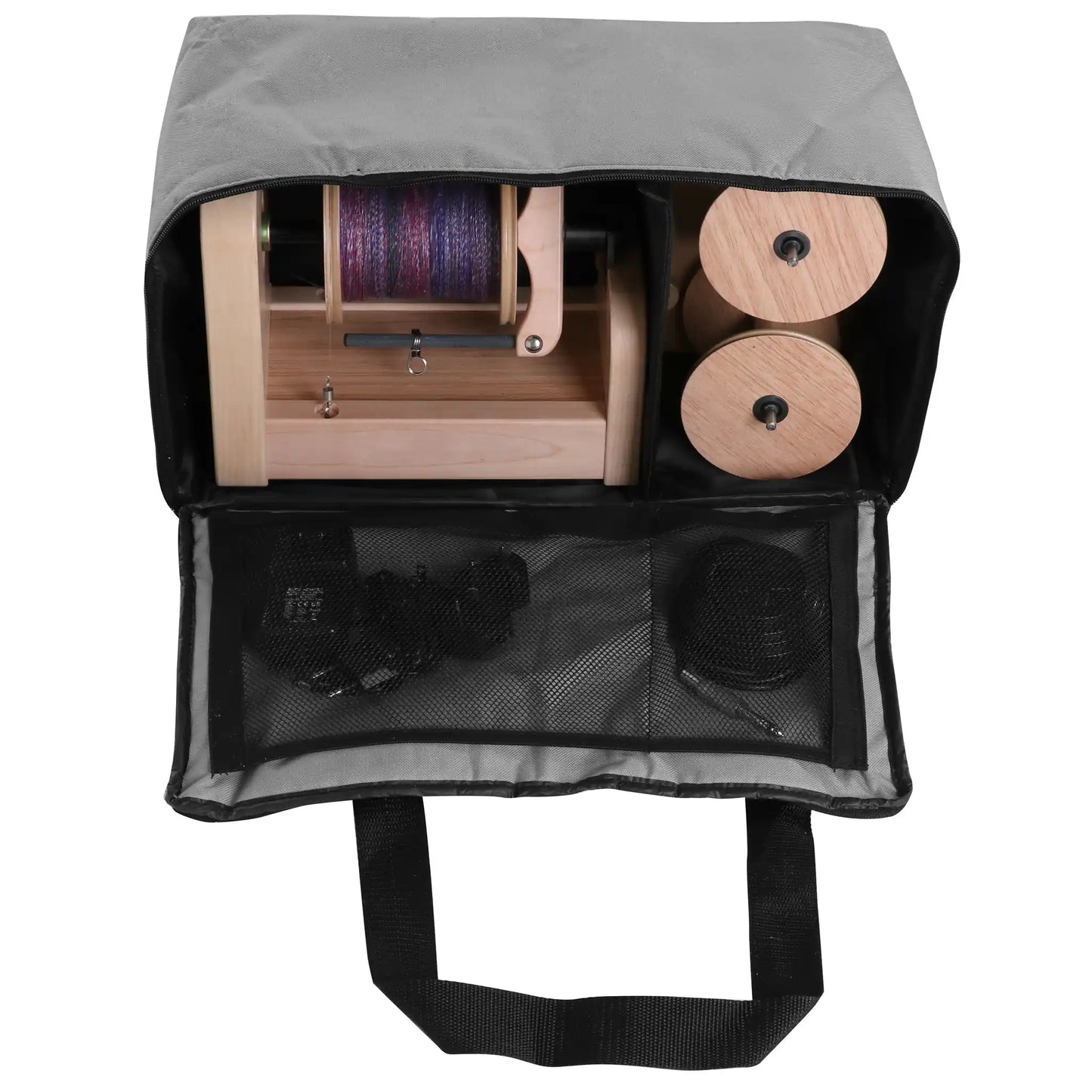
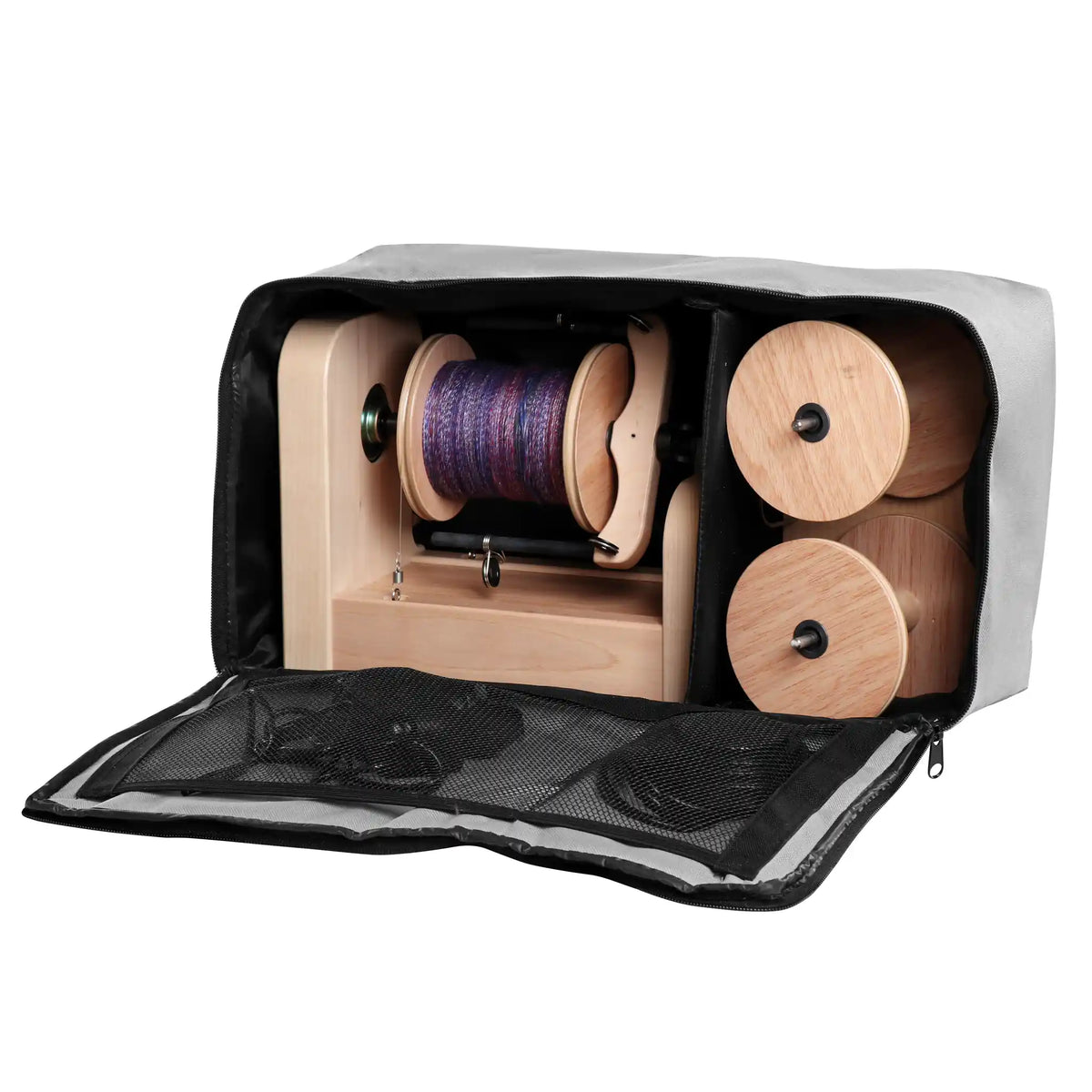
- Three jumbo bobbins, 225 g (8 oz) each
- Tensioned lazy kate, two bobbin positions, on its own base
- 100 to 240 volt AC/DC adapter
- On/off foot controller
- Padded carry bag with a mesh accessory pocket
- Brake band and spring set, 9 mm reducer bushing, threading hook, oil, Learn To Spin booklet
There is a little assembly: you cut the brake band to length, thread two screw eyes, and tap the two kate pins in. A small hammer is the only tool. Ashford's instructions are in the box, and the number at the bottom of this page reaches someone who has done it.
What it is not for
The 15 mm orifice is the ceiling. Genuinely bulky singles and art yarn want the wider orifice and much larger bobbin of the e-Spinner Super Jumbo. If you mostly spin fine to medium and want one machine for all of it, this is the one.
Questions people actually ask
Will it pull the yarn out of my hands when it starts? No. It has a soft start, so the motor takes two to three seconds to reach the speed you set. Ashford's own reason for building it that way is to stop the yarn being jerked out of your hands.
Does it keep running if I let go of the yarn? Yes, and this is the real difference from a treadle wheel. A treadle stops when your foot stops; this runs until you stop it. That is what the foot switch is for. Stop on the switch, not the speed dial, so you resume at the same speed.
How do I change a bobbin? Motor off. Two hands, one either side of the front bearing, lift and snap the flyer out, then pull it towards you out of the flexible drive. Swap the bobbin, hook the brake band back over the whorl, slide the flyer in and snap it down. Make sure it has snapped fully home before you start.
How does the foot switch work? I heard there are two modes. There are. On/off mode: switch the machine on, then tap the foot switch to start and tap again to stop. Ashford calls this the recommended mode. Hold-down mode: put your foot on the switch first, then turn the power on, and it runs only while you press.
Can I control the speed with the foot switch? No, the foot switch is start and stop only. Speed lives on the dial, so you set it once and use the switch to run, which keeps both hands on the fibre.
Why does it spin in both directions? You spin singles one way and ply the other, or the plies just untwist. Z twist (down) is spinning, S twist (up) is plying. Always stop the motor at the on/off switch before reversing.
What is the reducer bush for, and do I have to buy it? It is in the box. The orifice is 15 mm; drop the bush in and it becomes 9 mm, which stops a fine single vibrating. Drafting at about 45 degrees to the orifice removes almost all of the rest. Take it out for thicker yarn. It stores in a hole in the back.
The red light is flashing. Is it broken? Probably not. Short flash on, long off means standby: the speed is at zero or the foot switch is off. Long on, short off means the adapter is under load, which Ashford says is fine and cannot harm it. Oil the bearings, ease the brake band, drop the speed.
How tight should the brake band be? Tighten until the springs just begin to stretch. Never stretch them more than one and a half times their own length. Too much brake is the most common cause of a hot motor and a broken band.
My yarn keeps breaking. Or it kinks and will not feed on. Two different problems. Breaking: draft thicker, add a little speed, ease the brake band, oil the bearings. Kinking or refusing to feed: reduce speed and add a little brake. Change one thing at a time.
It sounds noisy out of the box. Is something wrong? Give it ten minutes. The motor ball bearings run in over the first five to ten minutes as the grease distributes, and it quietens down. A drop of oil on the flexible drive also helps.
Does it need assembling? Some. You cut the nylon brake band into two lengths, wax and thread two screw eyes, and tap the two lazy kate pins in. You will want a small hammer.
What powers it? Do I need to buy an adapter? A 100 to 240 volt AC/DC adapter is included and plugs into the 12V input at the back. For spinning away from power there is an optional 12V car cord. Using anything that is not 12V can damage the machine and void the warranty.
What can I spin with what comes in the box? A finished two-ply, start to finish, with nothing else bought. Fill two bobbins, put both on the kate, ply onto the third. A three-ply wants a fourth bobbin and a kate that holds three.
What speed should I use for a given yarn? There is no single dial setting, because twist is speed divided by how fast you draft. Start slow, let a length hang slack, and read it: a gentle curl is right for plying, a tight corkscrew is too much twist, drifting apart is too little.
It also winds weaving bobbins and works as a quill with the bobbin winder and quill attachment. Bobbins, cords and spares are in the e-Spinner collection.



Why Paradise Fibers?
Your trusted partner in creativity since 1997. Family-owned, expert-driven, and dedicated to fueling your passion.
Real "Fiberers" on Staff
Family-owned and staffed by passionate experts offering real advice to support your creative journey.
A World of Fiber
Over 20,000 in-stock yarns, fibers, and tools, shipped quickly to keep your inspiration flowing.
Trusted by the Flock
Serving over 250,000 happy customers with a 4.9-star rating based on 10,000+ verified reviews.
Frequently Asked Questions
Most in-stock orders ship within one business day from our Spokane, WA shop, and you'll get tracking as soon as yours is on the way. If an item is a special order or backordered, it says so right above the Add to Cart button.
Many of our products are beginner-friendly, and we make this clear in the product description.
You can also explore our kits and bundles, they include everything you need to get started with confidence.
Each fiber has its own feel and function. Merino is super soft and great for next-to-skin wear. BFL (Bluefaced Leicester) is strong, with a lovely luster. Need help deciding? Reach out! We’re happy to help.
For Yarn, check your pattern's yardage requirements. A standard pair of socks usually takes 100g of fingering weight, while a hat takes about 100g of worsted.For Spinning Fiber, a standard 4oz braid will generally make a pair of socks or a hat. For larger garments like sweaters, you will likely need 1.5 to 2 lbs of fiber.Still unsure? Send us your project details! We are happy to do the math for you to ensure you don't run short.
If a product goes out of stock after you order, we’ll notify you right away with options: a refund, a substitution, or a backorder (when possible). We never leave you hanging.
We offer 30-day easy returns on most unused products. If something arrives damaged or missing, we’ll make it right. Just contact our support team.
Yes! Our project kits and beginner bundles include hand-picked materials, tools, and instructions — so you can dive in without the guesswork.